
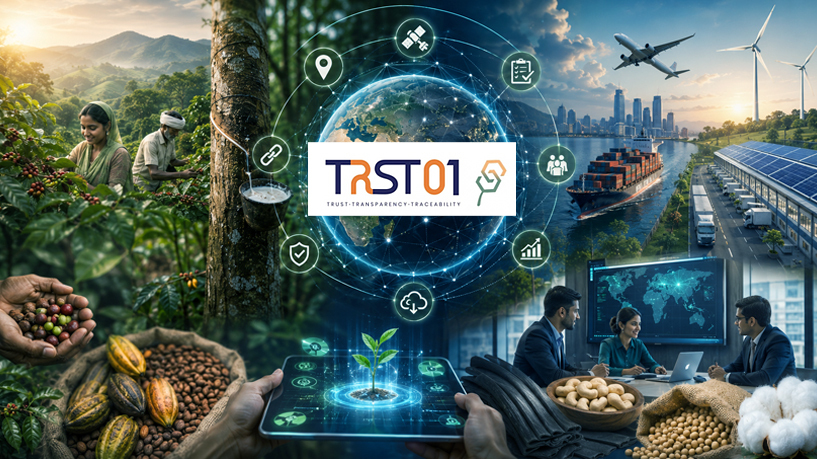
There is a story behind every cup of coffee we drink and every bar of chocolate we back. A story which goes back all the way to the hands that planted, nurtured and harvested the crops to the orchards where the seeds took first root. A story which remained invisible, along with the exploitative practices, deforestation, uncontrolled and unchecked emissions. Gone are those days and now buyers demand proof rather than fake promises and assurances, thanks to the strict and tight institutional regulations. Businesses which can show the source of raw materials, trace every step of procurement, production and logistics will be the ones that can keep up their markets. Traceability emerged as a critical factor in world market.
TRST01, emerged as a solution to this problem. Founded in 2019 to find real-world uses for blockchain, the company, registered as Trayambu Tech Solutions Private Limited and doing business as TRST01, began with a simple idea: trace food from farm to fork. That idea has since grown into a mission to make entire global supply chains traceable, accountable and net-zero ready. Today TRST01 transforms farm and supply-chain data into trusted digital public infrastructure, connecting identity, registries, geospatial intelligence and verifiable records into a single source of truth.
Headquartered in Hyderabad with a presence spanning Singapore, Australia and the USA, TRST01 delivers traceability, compliance and Environmental, Social and Governance (ESG) solutions to agribusinesses, exporters, manufacturers and policymakers across roughly ten countries. Its work reaches from the rubber estates of Côte d’Ivoire to the sugarcane fields of western Uttar Pradesh, wherever sustainability data needs to become measurable climate action.
TRST01’s core values sit on three pillars; Trust, Transparency and Traceability. And its products translate those pillars into working software for real industries. Rather than a single tool, TRST01 offers an interlocking suite that follows a commodity all the way from origin to regulatory report:
What sets TRST01 apart is that its technology lands in the field, not just the boardroom. As the official technology partner to the Rubber Board of India, TRST01 powers the iSNR (Indian Sustainable Natural Rubber) platform, the country’s national system for EUDR-compliant natural rubber, helping thousands of smallholders stay inside global export markets. Through initiatives like Kisan Samrudhi, it links healthier soil directly to farmer income by turning verified sustainable practice into carbon value. The through-line is consistent across everything the company has built:
The company focuses on the commodities where these stakes are highest, rubber, coffee, soya, cotton, cocoa, cashew and rice, and counts a growing roster of manufacturers, exporters and institutions among the organisations that rely on its platforms.
Some of the commodities TRST01 works with carry centuries of history. India’s coffee story began in the 17th century in the misty hills of Chikkamagaluru, where, as legend has it, the Sufi saint Baba Budan planted seven coffee seeds carried home from Mecca, seeding what would grow into the plantations of Karnataka’s Western Ghats. That region still anchors Indian coffee today: Karnataka alone accounts for roughly half of the country’s coffee exports, most of it grown under a canopy of shade trees.
That shade-grown, agroforestry tradition turns out to be a quiet advantage under the EU Deforestation Regulation, which through its 2025–26 deadlines, requires every batch of coffee entering Europe to be proven deforestation-free and traceable to the exact plot it came from. TRST01Chain maps those plots, runs the deforestation and risk checks, and records each step from bean to cup. This equips farmers and exporters to with audit ready proofs. Karnataka exporters such as Hangal Coffee have already adopted the platform to keep their access to European markets.
Rubber tells a parallel story at national scale. India’s roughly 850,000 hectares of rubber, spread across Kerala, Karnataka, Tamil Nadu and the Northeast, feed a tyre industry that ships the majority of its exports to Europe, making EUDR compliance a question of market access rather than a nicety. Here TRST01 works at the top of the chain as the Rubber Board of India’s technology partner behind the iSNR system, while TRST01Chain’s traceability now covers nearly 900,000 hectares of rubber across India, Indonesia, Malaysia, Vietnam, Thailand and Côte d’Ivoire.
TRST01’s work has earned steady recognition from industry, government and global platforms. The company received the Sustainability Impact Award 2024 at the UBS Forums Sustainability Summit, the AI in Agriculture Advancement Award 2024 from T-Hub and the Government of Telangana’s Emerging Technologies Wing, and the Aegis Graham Bell Award 2025. Its leadership was also featured among the Forbes India D-Globalists (Select200), celebrating founders building globally significant solutions. Earlier honours include the Innovation Leadership Award (2023) and recognition as a Best Emerging Blockchain Startup (2022).
Guiding the company are Founder & CEO Prabir Mishra and Global Director Manoj Vembu, pioneers in ESG-tech and blockchain who together champion a data-driven approach to sustainability with measurable impact at the grassroots.
Behind every scaling startup is an ecosystem that believed in it first. For TRST01, Amrita TBI was one of those early backers, providing seed funding at a formative stage. That capital, together with the incubator’s nurturing ecosystem, mentorship and network, gave TRST01 the runway to move from concept to a platform now trusted by exporters, manufacturers and government bodies. As a funded and incubated venture of Amrita TBI, TRST01 reflects exactly what the incubator sets out to do. Support founders with globally significant ideas, with capital and guidance through the fragile early years. Its growth into a multi-country climate-tech company, and the recognition that has followed, is a shared milestone for the startup and the ecosystem that helped launch it.